San Blas Islands
For PHOTOS —->> San Blas Islands
 The sail to the San Blas islands was a long tedious one. The seas in this area are generally huge and the winds had been light to next to nothing so unfortunately we had to use the motor for a good part of the passage. We had plans to go to Mulatupu, which is considered the 1st island in the group, and just off the mainland, but after seeing the seas rolling over the reef we changed our mind and headed to Isla Pinos.
The San Blas islands are a vast archipelago on Panama’s Caribbean coast. They are unique in many ways, home to the indigenousGuna Indians, who have kept their traditional customs and culture. As there is no  easy way to reach these islands, they have been cut off from “progress” as we call it. The associated mainland is called Guna Yala by the Gunas. They grow produce, but do not own the land as they share everything. The area has changed little since the Spanish first arrived.
The Gunas do not allow foreigners to, buy land, live or marry into their tribes. They are welcoming to visitors, peaceful, non-aggressive peoples. They live in  tribes/settlements of bamboo-thatched huts that each has an elder or tribal leader in charge. Most leaders do not allow any television, some do not allow any loud music and all maintain their traditional cultural ways. The people are all very small being one of the smallest peoples in the world.
The women make the Molas, a beautiful appliqué craft,  which comprises of intricately sewn layers of embroidered cloth in vibrant colors. The men go in their dugout canoes to farm, fish or collect coconuts. There are schools for the children. The elder children help by doing laundry, child minding and such chores.
Isla Pinos/Tupbak
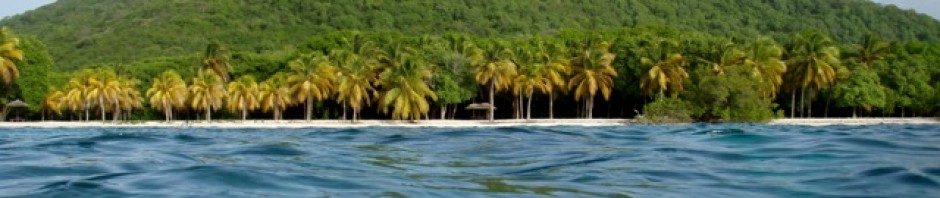
 Approaching this island was like walking into paradise. The palm trees line the white beach, the forested hillside form the background from where you can hear the birds calling. From out at sea the island forms the shape of a whale and is called by the Guna peoples Tupbak that means whale. It is one of the tallest islands at over 150 meters high.
We found that Lynne and Eric were anchored  there, hoping we would arrive. They had sailed in the day before from where we had last seen them.
We spent a lovely evening on the beach having drinks and catching up while swimming and enjoying the island. We had planned to stay and explore but didn’t, we will return there again.
Ustapu
 This is the largest village I the San Blas. We found our way there

 with difficulty. I think the number one rule for sailing/traveling by water here is to follow the waypoints in the Eric Bauhaus Cruising Guide to the exact degree and then also keep a close watch out for reefs, (twice those waypoints were off too). The area has no easy way through the reefs, it is treacherous! There is boiling water all around, huge swells, breaking water, sand bars and islands everywhere, a maze to try to travel through. Eric says that after years of sailing all over the world this area is the hardest. Bermuda is difficult to navigate if you don’t know the waters but the San Blas is 10xs that and more. However the journey is amazingly beautiful when passing the palm tree lined, white beaches of the small-uninhabited islands.
 After arriving at Ustapu around mid-day we
  went ashore to have a look around, plus to get sim cards, which we had heard, were available. We wandered the village from one end to the other through the tiny pathways of huts, past family compounds and guna villagers busily going about their affairs. Everyone was extremely
  friendly, wanting to practice their limited English and wishing us Feliz Navidad. The
  children were playing through the village, the boys flying kites and the girls with balls.
Eventually we found the Digicel place. Now this was inside a family compound. There was a hut where the cooking fire was burning away, grandmas sitting and fixing the beadwork on their legs, a  fellow in a corner with a huge shotgun he was polishing up and children playing on a mat on the earth floor. A surreal situation for a digicel! Out of one hut a lady sold us the sim cards for a few dollars. Plus minutes for a few more dollars. At another hut I bought bread rolls for 8 cents each. We were happy with our purchases.
We did not swim at Ustapu as we saw a crocodile that was 12 feet in length at least. The croc was not far from the boats he swished his tail and then sank to the bottom.
 Aridup
The next day we very carefully navigated our way to Aridup. Again the journey was beautiful but at times very  scary. However we live on the edge anyway. When arriving we were struck again by the beauty of these islands. Aridup is uninhabited, but when we went ashore we found 3 or 4 Guna men and a boy busily chopping up a boat, or a part of one. They keep the island clear of rubbish as much as possible by burning the waste that washes up along with the coconut husks and fonds. We found out later that the boat had been a 50 foot catamaran charter that had met with Spokeshave
  reef, been holed and sank. The 18 people aboard were
  rescued. This boat regularly traveled these waters with guests. The Gunas had coiled the rigging and had beers they had salvaged.
We walked around  the island, met Lynne and Eric with the boys, had a swim and went back to Aeeshah for a very rolly night. This is not a good anchorage. That evening we were surprised by a call on the VHF radio. It was Bad Bunny – John and Kay. They were in a nearby anchorage when a boat that dropped the hook near them had asked them to relay a message. They asked who to? When they were told they just cracked up with laughter, as it was us. In the anchorage with them was also Sorren our Swedish friend. We decided to head their way the next day being Christmas Eve.
Snug Harbour – Apaidup and other islands
Lynne and Eric decided to carry on, as they really needed internet. I was very happy to go into Snug Harbour where I could get ready for Christmas and have a few relaxing days from the traveling.
 We arrived in the morning and found it to be a very beautiful calm anchorage surrounded by tiny uninhabited islands. Our friends had made a Guna friend – Arkin. That evening we had a Christmas Eve celebration on the beach.
  Some Guna fishermen had sold us lobsters, plus a mix of veg on the fire and we had a feast. It was a wonderful full moon evening where everyone had a grand time.

Arkin had too much of John – Bad Bunny ‘s whisky to drink and he put on my John’s Santa hat with flashing  lights and set sail back home. I was quite worried about him. Well he turned up at Bad’s boat a short while later having lost his oar and
  could not row his canoe home so borrowed one and set off again.


Arrangements had been made with Arkin to meet  at his village on Christmas morning. Upon arriving the village was having a celebration in the square and a Colombian trading boat was there. Everyone was having a great time. We awaited the arrival of Arkin and after a while set off to his hut. Well Arkin’s wife took us in to
  find Arkin passed out with
  the world’s worse hang over in bed. We were shown the
  molas Arkin’s wife was working on and met his daughters too. A lovely family that work very hard to make a living. I delivered our “gifts” (some clothes, lollypops, candies, a cap and such) and off we set to do the river tour ourselves.
River tour
 We found the river after some help and up it we travelled for some miles. It really was picturesque. The reflections were wonderful, birds were everywhere and it was shady and cool. An
 excellent tour we gave ourselves, we went until we could go no further. That afternoon we went snorkeling and exploring on one of
  the nearby islands with Sorren. Again it was a lovely day,
a wonderful Christmas Day!
The following day, Boxing Day, we again explored the surrounding islands and swam. Walking around the island, looking for shells and doing all the pass times we love to do. Again each island is just so very special and beautiful!
While swimming off  the beach a canoe arrived with a family and 2 dogs. They all proceeded to swim, the children having a great time. Again they were such friendly happy people. The children were very natural with no pretenses, practicing their English on us. Before they left they gave us some yucca and plantains/bananas.
Rio Diablo and Nargana/Corazon de Jesus
We had originally been intending to stop at Devils Cays but upon arrival the anchorage was just too rough so it was onto Nargana, Corazon de Jesus and Rio Diablo. These are two separate villages that are separated by a bridge, so are really like one settlement. These are more progressive Guna settlements. The buildings are still primarily made of bamboo with thatch however there are more concrete buildings and there are services.
 We walked around the settlement, were able to find a “store” and buy a few bits and pieces. Plus we were able to buy some bread rolls, diesel and order water. The major bonus was the internet/wifi. There was enough signal to be able to call home, receive emails and get the weather, whoopee!!
River tour: Rio Diablo
Early, 7:30am on our second morning we went looking for the Rio  Diablo. Well it is not always easy to find the mouth of a river as the trees and mangroves grow right out into the bay. After some hunting we all, Eric, Lynne and Boys; Kay, John Bad, my John and myself, finally spotted a Guna boat heading into the apparent mouth.
 Up the river we slowly went avoiding sunken
  trunks, branches, and mud banks. This river was much wider than the last one, but just a beautiful. We saw many different birds of all types
  from woodpeckers to vultures to humming birds, birds of prey, and water birds.
We also saw quite a few Guna dugouts and  bigger wooden boat with containers heading up river. As we got to about 3 miles up river we could see that these local boats/canoes with the containers were actually collecting the water for the settlement. Yep, the water we had ordered was coming from up river, hummmm….. So it was decided that some bleach would be added to our water, much to my dismay. When we felt we could go no longer we stopped at a riverbank where the boys had a run around with their Frisbee. It was a lovely morning up the Rio Diablo.

 Green Island/Kanjildup and surrounding islands
We sailed to Green Island where we spent New  Years. Our 1st evening we had a great fish dinner aboard Amarula with Lynne and Eric. For New Year’s Eve evening we were aboard Bad Bunny with Kay and John where we had an excellent chicken dinner.
During the day we snorkeled the reef, dingied around, explored the islands and really enjoyed  the area with Kay and John. It is truly a very beautiful group of islands.
  Being closer to some sort of civilization there is a wifi connection, the Gunas make deliveries of vegetables, fish and lobster plus they have dug a fresh water well on one of the islands. We really enjoyed our time there.


 Porvenir
It was time to check in officially to Panama so we sailed to Porvenir. There you find a group of  islands, on one is immigration and customs office, a very small place to stay and an airstrip, (which only the smallest of planes could land on). However again it is very lovely.
Checking in was very easy and in fact we were given a coconut to drink. A guy was passing them to the Guna ladies and they offered them to us as well. The milk was delicious!
Following check in we dingied to the neighbouring islands and were able to buy some pan – bread! We had run out a few days prior.
 Chichime Cays Eastern Lemmon Cays
This was our next destination. We dropped anchor between Uchutupu Pipigua and Uchutupa Dummat, surrounded by reef that cuts the swell but not the breeze. It is a very lovely group of  islands on one a few Guna families live and on the other the Gunas have built huts for tourists to visit and even stay over night. Therefore it is also somewhat busy with the local taxi boats and the carter boat traffic. However that really didn’t bother us.
 We dinged to the reef and snorkeled everyday on the reef and in the shallows. The snorkeling was excellent. I found
 lovely shells; saw many rays, an octopus or 2 plus numerous fish. It really is so shallow over the reef and grass banks that scuba would never be necessary. On the outer reef there was a wreck of a sailboat, which John swam over the shallow
  reef, (about 2 – 1 foot deep), he of course climbed on top. We found several other wrecked sailboats on the bottom around the deeper reef. It really shows how treacherous the reefs here can be when you approach from out at sea. We also visited some of the Eastern Lemmon Cays about a mile or 2 away from us one day. Again they were just beautiful. We will have to return to them.


As we were just about out of all the foods and extras that make life comfortable we decided we needed to get to some sort of shopping area to stock up. Plus John had promised to do the transit through the canal with Amarula. So we were off to Shelter Bay Marina in Colon by way of Linton.

“You have to start by changing the story you tell yourself about getting older……The minute you say to yourself, “Time is everything, and I’m going to make sure that time is used the way I dream it should be used,” then you’ve got a whole different story.” Diane Sawyer
“Do not let your fire go out, spark by irreplaceable spark, in the hopeless swamps of the approximate, the not-quite, the not-yet, the not-at-all. The world you desired can be won. It exists, it is real, it is possible, it is yours.” Ayn Rand
 French Cay anchorage
 anchored in an anchorage sheltered by the reefs and a few cays. The only land access was through the Marina, but for $2:00 a day we also had the benefits of the Marina, trash dumping, transport to the grocery store and such. Lucky for us the day after we arrived was the day the vegetable/fruit man came, plus the transport to Eden’s the grocery store. T
 English mustard, HP sauce, marmite, red Tai curry, all the little luxuries were available. In fact we returned a second day too for more groceries and are now fully loaded again and prepared for Ethan and Rhianna’s visit.
 We explored the area in the dingy again it is very beautiful. We found a channel that on the charts showed that it went through to the other bay on the other side. Hopefully we followed it. Not a good idea, it ran along the
 back of homes and smelt of sewage. Just as we decided it was too shallow we got something stuck on the prop. Luckily there was a dad and his son outside their home and they leant us a knife cause it turned out to be a T-shirt, probably theirs, stuck around the prop. Anyway the canal was ruled out as access to French Cay Harbour.


 West Bay
 had to go through a narrow channel in the barrier reef.

 ‘town’.


 Harbour. On this cay they have built a
  John was quite skeptical concerning a dreaded biting insect, until he by the second day, was covered in large, very itchy, uncomfortable bites. Normally I am the one that the mosquitoes and no-seeums feast on, but not this time. Our neighboring boat, Landmark, with Colin and Anne were also eaten by this bug. They said it looked like a small flying flea like bug; I never saw it and luckily never suffered its bites.

 and print a
  picture of Aeeshah, we could only print in black and white though. Meanwhile having found an ATM, for cash, a internet place that sold SIM cards, plus the grocery store that did copies of our documents, we returned to the Port Captain. Picture was – “no good, need colour print! Go to Internet place and print a colour print.” Soooooo, off we go, get the colour print. By then it was later in the afternoon, I was shattered from lack of sleep, we were both well fed up. We get the colour print, go back and “no! Picture no good! Need picture of boat here!” Then he announces that he is off to measure a ship, so by then I/we had had enough, I left the colour print on his chair and we headed back to Aeeshah.
 were perfect, we could go anywhere,


 colourful restaurant on the hill across from the anchorage. Anne and Colin came with us; we landed the dingy on a dock, walked the steep hill to Mia Casa Too and found it to be just lovely. It is very brightly, but discreetly decorated with solid wooden furniture, a wide balcony with looks right out over the anchorage and Harbour. There is a wonderful breeze and the music is great. I had


 that it was occupied. The couple was the caretaker and his sister, they invited us in
 then to the top of the
 We enjoyed the view, had a snack and water and set off down for a challenging downward climb. The views were worth it, the scenery was lovely, but it was very, very hot.


 Hobbies Cays
 This passage was a


 John went for a rest as he had been up much of the night while I tidied up. Around 10:00 Bad Kitty showed up and then an hour later Landfall arrived.

 standing up straining to look for the adult birds for food.


 On route to Providencia we were sailing with
 rods, Jen to attend to Chico and the wheel. It looked to be 2 great fish, but unfortunately the 1st broke the line and the 2nd slipped the hook. Chico looked at John with a very disdainful look. Meanwhile Colin on Landmark was “shooting” the boat and fishing. Then just before we started to head in
 Meanwhile back to
  right along the shoreline where a there is a well laid path of pavers decorated with symbols of plants.
 To one side you look out over the shallows to the
  ranging from traditional wooden to new concrete design. Most homes being gaily painted with pretty gardens, others being more the working home of the fisherman or the laundress. Between the homes run pathway
  towards the hills or mangroves areas with crabs and lizards scuttling around. It was a lovely walk, but being the afternoon it was hot as in the direct sun with little shade.
 shade below the statue with the lovely breeze that was blowing and admired the magnificent view of 360 degrees. It really is a spectacular island. Above the statue was the remains of Fort Aury. We clambered up the hillside to the cannons, which were pointed out over the Harbour and agreed it was too hot to venture any further along the pathway.

 the mangroves. Again the pathway was interesting, at the end we found a sign telling us it was the site of where
 Morgan’s Head.


 was much algae which we assumed meant the water was just too still and hot. We headed around Isla Catalina in the dingy rounding the whole island on our way back to the boat. It is a very photogenic area.
 we hired a mule.
 later that all the bus stops are of unique design). This also was the entrance to one of the popular beaches. We walked down to the beach where we found a hut and some locals selling local music and
  trinkets. We ended up buying a CD and a pair of Lionfish fin earrings, which are quite unusual. The beach was empty but looked to be a popular spot. The 2-story hut was the home of the entrepreneur who lived there supplying drinks and trinkets to visitors. This structure was quite a colourful
  structure made from what looked like painted driftwood.
 Next stop was for mid morning coffee for the coffee drinkers. We found a
 horseracing beach.
 We drove on and found ourselves at the other end of
 Roland the owner was lying in
  his hammock swinging comfortably behind the bar. He saw potential customers and quickly jumped from his hammock and into action.

 various owners had taken much pride in their property.

 was morning the walk was far cooler and we passed the
 dropping ripe mangoes. John was thrilled to be able to pick up and eat ripe mangoes as he walked. On the return journey we collected a pile of mangoes, which we later picked up, from the beach where
 we stacked them.

 After lunch that day we
  snorkeling was good in areas and then disappointing in other areas. Unfortunately there is much coral bleaching and there looks to be large areas of damaged reef, maybe by boats.
 Our friends Colin and Anne had directions
  home on Isla Catalina.
 regular trail through the trees. It was an excellent walk.
 coast and then tracking uphill along an old stone walkway that was well overgrown to a wreck of what must have once been a splendid house on the hill. The property over looks the bay below and the whole island, but being so overgrown what once must have been excellent views were now glimpses through the trees. I would say it
  was a 2 story home with evidence of at least 2 bathrooms, an outlook from the roof area and a
  living/kitchen onto porch space, plus there was a pool. It
  We collected mangoes on the way back to make mango chutney. The trail had again been one with
  dozens of mango trees with hundreds of ripe mangos. John was in mango heaven!
  Our last day in Providencia we went with Colin and Anne plus
  two other couples to
  he has the most horses on the island and his horses are some of the racers.

 We started at the trailhead with Hawkins
 Hawkins was a brilliant guide;
 it wasn’t too hot. We wound our way to the top, which as expected had an
  If it had been a sunny day the view would have been stunning, but it was pretty special anyway. Hawkins is at present
  reestablishing another way to head back, but for now we had to head back the same way. Making the whole trek

 Our time was spent
  up supplies so this required a 2 hour bus ride to get to a
  could also carry piles of groceries and crates of beer.
 container into liter plastic bottles the desired amount of fuel, be it gasoline, diesel or what ever. This is on the porch, the fuel containers/barrels are kept in the front room of the house where you will also see babies being cared for, children, TV playing and life going on as normal. Just another day in Panama!
 white beach we were surprised by a small strip of sand under the trees with houses above and cows grazing. It’s never as you imagine.
 Finally John felt we could head off, probably having to motor for the first part, but leave we did.
 motoring, and the seas were a bit steep, but we were finally off. The first 24 hours were fine, we even


 miles and part of a small group of cays. It has an English history that started with the Puritans who were also involved in New England. There is a history of piracy, Henry Morgan being just one notable pirate to hide away there. There is a short Spanish history in Colonial times, then settlers from other Caribbean islands also settled including many former slaves from Jamaica. Plus the island has been part of the


 duty free shops. I prefer the older part of town where the shops are small and jammed pack with any type of thing you might need. This is where you find the locals shopping, the bargains and the excellent fresh fruit. We even saw the famous


 that are up on
 those rocks and reefs so guessing there must also be many boats lost on these shores too. The beaches along this shoreline are
  of the beautiful beaches along the way.


 rest of the day was spent finding necessary parts for Steve’s water maker and picking up our heavier supplies like crates of beer to stock up the boats. All in all we had a fun day!
 We had not been able to see the famed
 miles in the hot sun we found the hill. Up we climbed passing a very untidy neighborhood, trash everywhere, stray dogs, cats, kittens, and kids. A totally different side of the neat and tidy San Andres of the shoreline roadway. Maybe this is why the mule/golf cart can’t go up there.
 Finally reaching the top we went along a little bit further


 Gavin and Katie’s daughter
  around. She is incredibly interested in everyone and everything.
 Such a inquisitive, lovely, cuddly, baby girl. We visited as much as we could wanting to spend as much time with Lily as possible.
 In Bermuda Good Friday is a special day.

 materials.
 Other important traditions, which we enjoy, are


 have a wonderful day together.


 The next day while at my son’s house we had a phone call from Westmeath where my Dad is a resident/patient. My Dad had fallen and had a bump on his head, would we come and have a look and take him to be checked.
 bad for some years now, but that day it was very bad. Plus he kept repeating certain behaviors.


 Gavin and Katie’s new boat
 We went towards
  conditions were beautiful with wonderful reflections upon the water.


 Walks with our dogs:


 grave is situated in St James Churchyard
 of the surrounding graves are also of extended family members. It was a Sunday and so we could hear the service going on inside the old church. The churchyard is quite a lovely one with huge cedars of 100s of years old.
 public dock
 out of Dockyard and
  Gavin
Gavin
 was wonderful!! And then it was time to return to Aeeshah.


 points almost a vertical assault. What had happened
  over the few hundred years since the battery had been built was erosion of the hillside. It was now a
  gorge, where one has to climb the sides. It is a pretty hike as the steep hillside is grassy and looks out over the entire bay. We reach the battery but it is in disrepair so to climb into it one needs to enter the moat and climb the walls. Not looking safe we gave that a skip. Plus I had learnt by then that all kinds of wasps live in nests in such walls and they do not like to be disturbed.


 originally being brought to the top of the ridge those hundreds of years ago?


 1st John explored the upper fort again, climbing its walls and checking the view.

 Then into the jungle we went. We found this path again more or less followed a ridge. I think the property line –barbed wire fence – that had been erected created it. It was wonderful hiking through the enormous trees, again listening to the birds. Sometimes we actually saw the birds, but most time they are well hidden in the foliage. We did see
  plenty of interesting insects and spiders. John being the “leader” was plagued
 by spiders and their webs, guess that comes with being the leader. We could hear the Howler Monkeys off in the distance and really hoped to see them, but never did. Well we hiked about an hour and a half trying to reach the other end, wherever that might be just to reach basically a dead-end. We could have bush-wacked our way onwards, but felt in the heat, with less than half our water left we should head back. The journey back took just 45 mins.
 Linton Bay Marina


 Once we were in the marina we were able to enjoy our bikes. Sorren too has a bike so we set off to see what we could find.

 (mind you I usually push it up the steep hills). We passed the Panamarine entrance, continued on to a small fishing settlement,
 Jose del Mar,

 Isla Grande
 shoreline which goes from one end of the island to the other.
 Heading east we enjoyed the quaint shoreline buildings. They were all colours with multiple decorations from shells to tiles to make each distinct in its own right. The islanders obviously take pride in their properties. There was no trash, which
  was a refreshing change from the mainland.
 Having reached the pathway heading up we assumed correctly it lead to:
 up we climbed to the top.
 Reaching the top, I kid you not,
  headed down. We then set off along the same path back the way we had walked and then
  onto the other end of Isla Grande. I was very scenic and easy to see why it was so popular with the local tourists.
 Catching local busses
 region it requires traveling to the nearest ATM. This is a over an hour in a bus, usually two hours, or an hour in a fast taxi. The least expensive is a bus ride for $2.00 as opposed to maybe over $40.00. Off on the bus we had to travel several times.
 the local busses. An experience that everyone should try. The busses are old USA school busses which were left when the Americans left Panama. Each driver has decorated the busses according to his taste, (never seen a female bus driver yet). He drives as he feels speeding up to super faaaassst then for no apparent reason creating along veeerry slowly. Our 1st bus had
  outsides are normally decorated with extravagant
  pictures usually including Christ, I guess as a Blessing. The music again is up to the driver’s taste. This can be mind blowingly loud and ugly as in our 1st bus ride or wonderfully rhythmic Spanish tunes. One is lucky to get a seat as the busses are normally full, so try to catch them early. The locals are all
  very friendly and the atmosphere on the bus is one of terrific endurance. Our
  trips took us to
 Panama City
 Panama City.

 We visited the
  and enjoyed wandering around looking at the old architecture.
 and reduced most of the city to ruins. A new city was built nearby at Cerro Ancon in 1673 where today the old quarter is closed to traffic and very pleasant to wander around the old streets.
 We found a fantastic Yogurt cafe where you could choose any flavors of yogurt, all natural and healthy, then put any types of toppings on your yogurt. There we had a wonderful refreshing treat!


 American business center.
 There are the world’s tallest residential buildings – over 100 floors – other skyscrapers of very interesting design make an interesting skyline.

 We went back to Nargana to get some water
 Saturday many of the Nargana town folks were also headed up the river off to get water and for the ladies to
  do their laundry. Heading up the river is just lovely, the jungle is beautiful, the bird noises are incredible, seeing them is not easy unless they are brightly coloured. Butterflies and insects fly all round and the water is so clear you can see the river fish. Once upriver we went
  upstream from those doing laundry and having a wash and decantered
  our water. It was a fun expedition.


 countryside is very lovely.
 Shelter Bay Marina
 using wifi and laundry at last, and going for bike rides and outings.
 we saw tiny spider monkeys leaping
  across the lane from tree to tree. There were virtually no others along the lane and riding under the jungle canopy is lovely even in the high 80s. The beach where we stopped was completely deserted and we had a very nice walk along it. I was particularly happy to find many great shells, cowries and tulips to name a few.
 Another bike ride we took was
  the observation tower in the jungle
 many birds and insects but seeing them is really difficult unless they are brightly coloured they are well camouflaged in the dense jungle canopy. We arrived at the end of the trail and found no tower. However you could see out somewhat over the jungle. We later found out the platform, built by the Americans had been there 20 years ago but like
  much of the American base it has returned to the jungle. The park service just keeps the trail open now.


 Embera Village visit.
 a visit to an
 of Panama. During the colonial era they proved to be a valuable ally of Maroons, such as Bayano and Felipillo. The legacy of the symbolic relationship is still alive and well in the upbeat tempo of their music, product of the African drums. Embera people are the only indigenous people in Panama
  that have the drum as a part of their musical instruments.
 We were taken by
  ride to and along the shores of the
 craftwork was displayed.
 and set ablaze at the end and the cooking pot is put on top. It is a very hard wood and lasts several weeks before they need new logs.
 What was most interesting to me was their history. They lived originally in the region where the Gatun Lake is now found. When it was decided to build the canal it was necessary to flood the area thus creating
  what is now the huge Gatun Lake. Around the lake was to be all
  warning. They were told they could continue to live in the area but could no longer hunt the deer or wildlife, nor could the farm
  their rice and other crops. So the Embera peoples decided to adapt to the new lifestyle. They create their wonderful crafts, trade, and
  work in nearby communities while still
  following their original culture. Asking about their matrimonial “system” it was explained that no two from the same village or community can “marry”. The leader said
  he set off at 14 crossed the country and found his wife in the village we were in. He then had to prove his worth by building a home and establishing himself before she would become his. Quite progressive thinking I think.
 very tasty, cooked banana and plantain all in a banana leaf cone.
 plus allowed to wander around the village. Watching the children was a highlight. They are
  very innocent and so very lovely.
 Our first stop along the coast of


 the Thursday late afternoon. They went through a series
  of locks and rose upwards towards the
 this in each lock. He said it was really easy. They spent the night on Gatun Lake tied to a buoy. The pilot arrived at 10:00 the next day, (only 3 hours late), and they crossed the lake. The lake he said was very beautiful with just jungle at the sides and islands that again were just jungle. They could hear the howler monkeys.
 Meanwhile I stayed
 where I started stocking up with supplies.

 scream like monsters


 some vultures. These
 to
to 


 the American base, but it was
 We went to the

 1597 under the name of the
  restaurants. The ruins of the
  is encroaching and reclaiming the area. The fort on the southern side of the bay is being restored. It was interesting to walk around and see all the canons facing out to sea. In fact in all the forts in the Portobello area there are
  at least a few dozen canons still facing out to sea. We visited the old church and saw the famous Black Jesus who was brought to Portobello hundreds of years ago and today is reputed to be responsible for miracles, hundreds come to pray to him.
 We hiked to the top of the fort above the boat. This is a 3-layered fortification. The 1st being at sea level
  then up a steep incline is the second level and after a longer even steeper climb we found the top
 fortification that looks out over the whole bay. The view is just amazing. Once again we could hear the howler monkeys making off in the jungle around us
  and saw dozen of beautiful butterflies and all kinds of exotic birds. We watched the leaf cutter ants as they trudged along with massive leaves attached to their back. Their pathways are several inches wide. They are quite impressive insects.
 Leaving Portobello we decided to
  cat sitter for Chico. Our plan was to visit
  the return monkeys!

 channels and found them to be exceptionally beautiful. Took a hike to the little


 San Blas Islands: Lemmon Cays


 We headed to the
 While there we walked around Waisaidup and found a few Gunas
  living there, probably to tend the huge coconut forest. The waters were all colours of turquoise with the shallows rolling ashore it was absolutely idyllic.
 were magnificent corals of all types, schools of all different fish, eels in the rocks the reef was alive with life.
 dolphin chasing the school of Jacks, which were chasing the Fry as pelicans swooped and plunged into the water. Chico was very entertained with the life around the boat. This is definitely an anchorage where we will return and spend more time.


 Being mindful that the weather was deteriorating, that we had not had wifi for some days and we needed supplies we moved to